If you want to exercise for longer and perform at your best, one thing is clear, carbohydrate intake during exercise matters. It helps maintain energy availability; delays fatigue and supports sustained performance. What has changed in recent years is how much carbohydrate endurance athletes are now consuming.
In professional sport, including cycling, triathlon, and marathon/ultra running, intaking carbohydrates at a rate 120g per hour or more is no longer unusual. What once seemed excessive is now becoming increasingly common.
In this article, we will explore the rationale behind high carbohydrate intakes during exercise, who may benefit from high carbohydrates intakes, and how a new TORQ Product provides a cutting-edge nutritional tool to reach these high intakes efficiently and effectively.
Why are carbohydrates key for endurance exercise?
When it comes to energy production within the body, there is a single universal currency used by every cell: adenosine triphosphate, or ATP. ATP powers the processes that keep us alive, including the muscular contractions that allow us to exercise. Whether you are cycling, running or swimming, ATP is the immediate source of energy making that movement possible. The limitation is that our ATP stores are extremely small. On their own, they would only support exercise for a matter of seconds.
To overcome this, the body relies on larger different types of energy stores to continually resynthesise (make) ATP. This happens through oxidation (the release of energy), using carbohydrate and fat as fuels. We store both in the body, but their contribution changes depending on exercise intensity. At lower intensities, fat provides the majority of energy. As intensity increases, carbohydrate use rises and fat contribution falls. Beyond a certain intensity, carbohydrate becomes the dominant fuel source. The challenge is that carbohydrate stores are limited. Carbohydrate is stored as glycogen in the muscles and liver, and these stores are progressively depleted during prolonged or high-intensity exercise. Once glycogen levels fall too low, sustaining that intensity becomes impossible, forcing a reduction in pace or, ultimately, the end of exercise.
So how can we maintain exercise at a higher intensity for a prolonged period of time?
Ingesting carbohydrates during exercise provides another source of carbohydrate for your body to use and are referred to as exogenous carbohydrates. Taking carbohydrates on board during exercise maintains carbohydrate availability, and therefore fuel availability for exercise. It has been shown to spare liver glycogen stores, preventing low glucose concentrations during exercise and maintaining a high rate of carbohydrate oxidation, which can increase your endurance capacity.
Initial recommendations at the turn of the millennium suggested that consuming 60g per hour was sufficient to sustain exercise performance, as it was thought this was the maximum amount of carbohydrate that could be delivered to the working muscle. This recommendation still holds true today for a large proportion of exercise contexts. In fact, at TORQ we would recommend fuelling 60g per hour (or 2 TORQ Units) for much of your training, particularly sessions of low to moderate intensity and less than 2.5 hours long. However, research in the 2000s demonstrated that the 60g per hour ‘threshold’ can be overcome by utilising multiple-transportable carbohydrates: namely glucose and fructose.
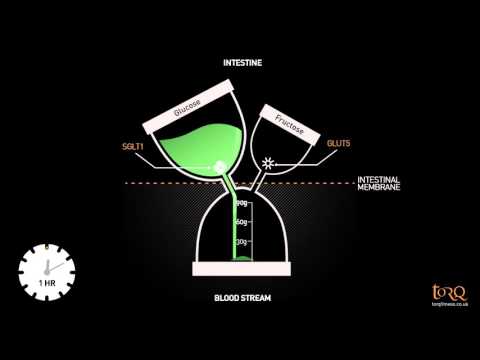
Animation demonstrating how glucose absorption is limited in most individuals to around 60g per hour due to the capacity limits of intestinal transporter SGLT1.
Researchers discovered that greater intakes of carbohydrates could be digested and oxidised during exercise via ingesting glucose and fructose. The science behind this is well established. Glucose and fructose use different intestinal transporters, allowing the body to absorb and utilise far more carbohydrate than glucose alone. Glucose is absorbed via the SGLT1 transporter and fructose via the GLUT5 transporter in the intestinal wall. When athletes rely solely on glucose derivatives, exogenous carbohydrate oxidation rises but quickly plateaus at around 60g per hour (with an absolute peak of ~ 72g per hour in some individuals). Increasing intake above 60g per hour does not meaningfully improve oxidation or performance. It was shown however, that combining glucose with fructose significantly elevates exogenous carbohydrate oxidation. From this research, the guidelines, which still stand today, were updated with the recommendation that you should be consuming 90g per hour of multiple-transportable carbohydrates – glucose and fructose – a 50% greater total carbohydrate than if consuming glucose derivatives alone. The term ‘glucose derivatives’ refers to glucose, maltodextrin or other polymers of glucose – glucose can take many forms.

Animation demonstrating how the introduction of fructose into the carbohydrate mix takes advantage of intestinal transporter GLUT5 for higher overall carbohydrate delivery.
The ratio of glucose derivatives to fructose primarily used within this work was 2:1, meaning two parts of glucose for every part of fructose. This means that at 90g per hour, you would be consuming 60g of glucose and 30g of fructose.
The evidence base behind 2:1
The 2:1 ratio has been the cornerstone of endurance fuelling strategies for almost two decades, it is the ratio used in most of TORQ’s energy products, and for good reason. A substantial body of research demonstrates its effectiveness in increasing exogenous carbohydrate oxidation rates.
A pivotal study by Wallis et al. (2005) compared the ingestion of maltodextrin alone with a mixed-carbohydrate approach combining maltodextrin (a glucose polymer) and fructose. Despite identical total intakes of 108g total carbohydrate per hour, the mixed formulation produced higher oxidation rates, reaching approximately 90g per hour.
From this work, the practical upper recommendation of 90g per hour was established, balancing maximal oxidation with gastrointestinal tolerance for most athletes. The rationale was ‘why consume more than 90g per hour if the rest isn’t oxidised?’ As a result, the 2:1 ratio became the standard fuelling strategy for endurance exercise with a position it continues to hold across many training and racing scenarios today (Thomas et al., 2016).
Higher consumption rates
In recent years, reports of increasingly high carbohydrate intakes during exercise have become more common. Consuming 120g per hour seems to be a common practise amongst athletes these days across the spectrum of endurance sports, with some pushing even higher intakes in the search to further improve their performance. Although high intakes may be in vogue, the thought that consuming greater than 90g per hour for the performance benefit has been around for a while. Data from Ironman triathletes shows a significant correlation between race finish time and carbohydrate intake – simply put, higher carbohydrate intakes were associated with faster finishing times (Pfeiffer et al., 2012). The more they consumed, they faster they were.
To further investigate these findings, scientists have conducted several studies over the years to establish whether higher intakes may be beneficial for athletes. Within the laboratory, several studies have investigated intakes above the current recommendation of 90g per hour. It should be noted that the main focus for most of these studies has been on exogenous carbohydrate oxidation – the amount of the ingested carbohydrate that is used to fuel exercise – and is typically reported in grams per minute (g·min⁻¹). Another focus has been on exogenous carbohydrate oxidation efficiency. This is the amount of exogenous carbohydrate that is oxidised relative to the total amount ingested. Oxidation efficiency is reported as a percentage. A higher oxidation efficiency means that more of the ingested carbohydrate is oxidised, contributing towards the fuelling of exercise, and there is less residual carbohydrate (unused carbohydrate), which may cause gastrointestinal issues if it remains in the gut.

King et al. (2018) compared ingestion rates of 90g per hour and 112.5g per hour using a traditional 2:1 glucose-to-fructose ratio. Interestingly, exogenous carbohydrate oxidation was higher at 90g per hour, with no additional benefit observed at the higher intake. This suggests that when using a 2:1 ratio, increasing glucose intake beyond a certain threshold does not further enhance oxidation and may exceed absorptive capacity.
In contrast, Podlogar et al. (2022) compared 90g per hour delivered at a ratio of 2:1 and 120g per hour delivered at a ratio of approximately 1:0.8. In this study, the higher intake resulted in elevated exogenous carbohydrate oxidation rates. However, oxidation efficiency was greater at 90g per hour, and fat oxidation was more strongly suppressed at 120g per hour, highlighting the metabolic trade-offs associated with very high carbohydrate intakes.
Hearris et al. (2022) further demonstrated that 120g per hour at a 1:0.8 ratio can be tolerated within cyclists. Importantly, this work also showed that carbohydrate form (e.g. drink vs gel) did not meaningfully influence oxidation efficiency, reinforcing the importance of total intake and ratio rather than format alone. Mixing CHO intake across the forms within the TORQ Fuelling System range is entirely valid, with all products equally contributing to the carbohydrate used.
Earlier work by Jentjens and Jeukendrup (2005) reported high oxidation rates following ingestion of up to 144g per hour of carbohydrate provided in a 1:1 glucose-to-fructose ratio, further supporting the concept that ratios approaching unity facilitate very high oxidation rates when intakes are very high.
More recently, Ravikanti et al. (2025) investigated 120g per hour at a 1:1 ratio during running, demonstrating some of the highest exogenous oxidation rates ever recorded and a sustained contribution of carbohydrate to total energy expenditure.
It was the findings of these last two studies, carried out 20 years apart, that supported the notion that TORQ should produce a range of 1:1 products, aimed specifically at those committing to ultra-high carbohydrate intakes.
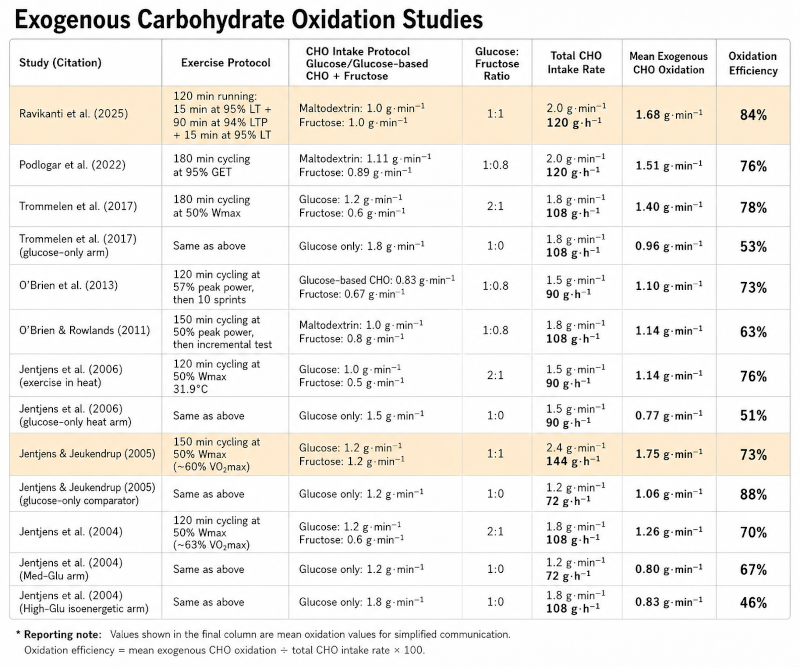
Table summarising the research over the last two decades. Studies investigating 1:1 ratios produced the highest oxidation rates ever recorded.
To establish oxidation efficiency – which to remind you, is the amount on endogenous/consumed carbohydrate that’s actually burned – simply divide the amount oxidised into the amount consumed and multiply by 100. This % is presented in the last column. The Ravikanti et al (2025) study reveals how effective and efficient a 1:1 formulation is at ultra-high intakes.
Interpreting the bigger picture
Higher exogenous carbohydrate oxidation helps sustain whole-body carbohydrate oxidation, which may reduce reliance on fat oxidation and, in some contexts, lower the oxygen cost of exercise. These metabolic effects provide a plausible mechanism through which very high carbohydrate intakes could enhance performance, particularly during prolonged, high-intensity endurance exercise. That said, direct evidence linking intakes above 90g per hour to clear performance benefits remains limited, and results across studies are mixed. What is becoming increasingly clear, however, is that carbohydrate intakes in the range of 90–120g per hour are not only achievable for many athletes but can meaningfully increase exogenous carbohydrate oxidation and maintain a high contribution of carbohydrate to energy supply – provided that intake strategy, carbohydrate ratio, and exercise modality are carefully considered.
As the evidence base continues to evolve, these findings support a more nuanced view of carbohydrate intake during exercise, where higher intakes may be appropriate for certain athletes and scenarios, rather than a one-size-fits-all upper limit.
Higher carbohydrate intakes during exercise and the case for 1:1 or ‘Unity’
A finding within the carbohydrate metabolism literature is that the highest exogenous carbohydrate oxidation rates are achieved not only by increasing total carbohydrate intake, but by carefully manipulating the ratio of glucose to fructose. In particular, studies have shown that oxidation rates continue to rise when carbohydrate ratios move closer to unity (1:1) – a concept first described by Rowlands et al. (2015).
This raises an important question for modern endurance fuelling strategies: where does a 1:1 glucose-to-fructose ratio, such as that found in the new TORQ 1:1 Proto Fuelling range, fit, and what role does it play alongside more established formulations such as 2:1?

When higher intakes demand a different ratio
As carbohydrate intake during exercise increases beyond 90g per hour, a ratio approaching unity may become preferable. At very high intakes, the absolute amount of glucose delivered to the gut becomes the limiting factor. For example, consuming 120g per hour of carbohydrate in a traditional 2:1 formulation delivers 80g of glucose. While some athletes can absorb and oxidise glucose at rates above the commonly cited ~ 60g per hour ceiling, for most individuals this amount will exceed their intestinal transport capacity. The result is an increased risk of gastrointestinal discomfort and reduced overall carbohydrate oxidation (oxidative efficiency).
By increasing the proportion of fructose and decreasing contribution of glucose – moving the ratio closer to 1:1 – the total carbohydrate load can be distributed more evenly across different intestinal transporters. This allows for higher overall intakes to be absorbed, oxidised and tolerated. In practical terms, a ratio approaching unity can help athletes successfully reach very high carbohydrate intakes during prolonged or ultra-endurance exercise. In this example, consuming 120g of carbohydrate per hour at a 1:1 ratio would deliver 60g of glucose, which is well within the tolerance threshold for most athletes. This ratio also further supports athletes with greater glucose absorption capabilities, who could potentially push beyond 120g per hour, up to 140-150g per hour – the doses given to athletes in the studies by Jentjens and Jeukendrup (2005), and Ravikanti et al. (2025).
Why 2:1 still makes sense below 90g per hour
At 30–90g per hour, most athletes will not come close to saturating their capacity to absorb glucose. In this context, prioritising glucose makes physiological sense. Glucose is readily used by the working muscles, whereas fructose must first be converted in the liver before it can contribute to energy production in the muscles. When total intake is moderate, supplying a greater proportion of immediately usable fuel as glucose will be beneficial.
Another important consideration is that ratios with a higher proportion of fructose like 1:1 and 1:0.8 are more difficult to absorb at lower overall carbohydrate intakes. This is because glucose is a key facilitator in the absorption of fructose, so if there isn’t enough glucose in the formulation, fructose can remain trapped in the gut, with the potential to cause gastro-intestinal distress. This mechanism is explained in deeper detail in our article: TORQ 1:1 Proto – Deep Dive.
For carbohydrate intakes of 90g per hour or less, a 2:1 product solves these problems.
There are also practical considerations. A higher proportion of glucose polymers (such as maltodextrin) reduces overall sweetness, which may improve palatability and tolerance during long-duration exercise – an important factor in real-world fuelling success.

Positioning ratios along the intake spectrum
Rather than replacing the 2:1 approach, carbohydrate ratios approaching unity should be viewed as a strategic progression for athletes targeting intakes between 90-120g per hour and beyond. For many training sessions and competitive scenarios, 2:1 remains an ideal fuelling strategy. However, as energy demands increase and athletes push beyond 90g per hour, a 1:1 ratio provides a logical and evidence-based solution to maximise absorption, oxidation and tolerance. In this way, both ratios have a clear and complementary role within modern performance nutrition.
Should I be consuming 120g+ per hour in every session and race?
The short answer is no, but it is worth understanding when and why very high carbohydrate intakes may be useful and equally, when they are not. So, when might 120g+ per hour be appropriate?
From a practical perspective, higher intakes are most relevant when energy demand is exceptionally high, such as during long-duration, high-intensity contexts, like during competition, where energy expenditure may exceed 1000 kcal per hour.
Despite the potential benefits, consistently fuelling at very high carbohydrate intakes is neither necessary nor desirable in all contexts. A periodised approach to carbohydrate intake, aligned to the demands of your training session or race, remains essential. Many coaches and researchers use the expression ‘fuel for the work required’ and this is as true today as it ever was. The ability to utilise fat as a fuel source is a critical component of endurance performance and should be developed through training and utilised during competition when intensity allows (for example, lower-intensity phases of racing). Research suggests that the ability to tap into fat metabolism could be negatively affected by consistently high (ultra-high) carbohydrate intakes.
At lower exercise intensities, ingesting very high carbohydrate intakes will:
– Maintain a high contribution of carbohydrate to total energy expenditure
– Increase reliance on both exogenous carbohydrate and muscle glycogen
– Potentially accelerate glycogen depletion despite high intake
Crucially, because energy intake capacity over the day is finite, consuming excessive carbohydrate during lower-intensity exercise may reduce the available “budget” to fully restore glycogen stores post-exercise. In other words, you may not be hungry enough to consume carbohydrate when it matters! In multi-day training or racing scenarios, this can negatively impact performance on subsequent days.
There is also the practical consideration of gastrointestinal distress, which becomes more likely as intake increases. While this can be mitigated through gut training, it remains a limiting factor for many athletes. For further information on gut training, read our article Don’t Fuel Gastric Discomfort.
If higher intakes are appropriate for your event or session, they should be implemented deliberately and you should consider the following:
– Gut train: progressively increase carbohydrate intake during training to improve tolerance.
– Match intake to demand: reserve greater than 90g per hour intakes for long, hard, or race-specific sessions or races.
– Use appropriate ratios – employing a ratio strategy closer to unity by utilising the new TORQ 1:1 PROTO range allows total intake to increase while effectively ‘clamping’ glucose intake around 60g per hour, reducing the risk of overloading glucose transporters in the gut.
Below is an example of how total carbohydrate intake can be increased above 90g per hour by combining TORQ 2:1 and TORQ 1:1 PROTO products, while managing glucose load:
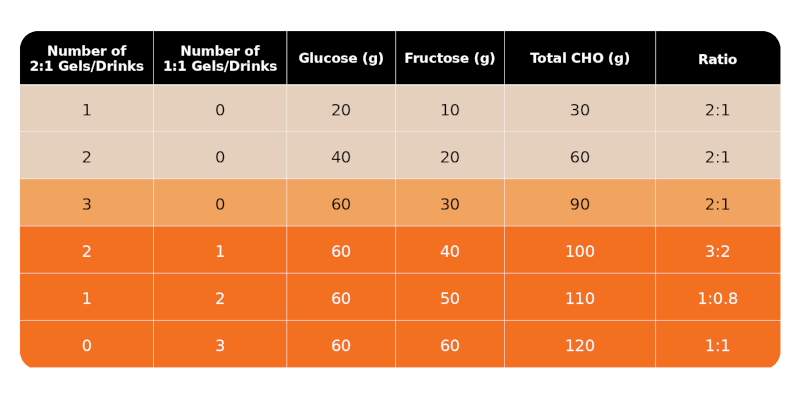
This approach allows athletes to push total carbohydrate intake higher without continuously increasing glucose beyond tolerable limits. From 90g total carbohydrate intake and beyond, glucose is effectively ‘pegged’ at 60g per hour.
The take-home message
Ultra-high carbohydrate intakes are a tool, not a rule. For most sessions and many races, up to 90g per hour, using TORQ’s 2:1 ratio products remains highly effective. Intakes of 90–120g+ per hour, utilising the new TORQ 1:1 PROTO range, are likely to be beneficial in specific high-demand scenarios, but only when applied strategically, tested in training, and matched to the physiological demands of the task.
If you’re interested in this subject and want to learn more, we highly recommend that you read our article TORQ 1:1 Proto – Deep Dive.
If you have any questions about this article or anything else on this website, please don’t hesitiate in contacting us on 0344 332 0852 or email enquiries@torqfitness.co.uk
References:
Hearris, M. A., Pugh, J. N., Langan-Evans, C., Mann, S. J., Burke, L., Stellingwerff, T., Gonzalez, J. T., & Morton, J. P. (2022). 13C-glucose-fructose labeling reveals comparable exogenous CHO oxidation during exercise when consuming 120 g/h in fluid, gel, jelly chew, or coingestion. Journal of Applied Physiology, 132(6), 1394-1406. https://doi.org/10.1152/japplphysiol.00091.2022
Jentjens, R. L. P. G., & Jeukendrup, A. E. (2005). High rates of exogenous carbohydrate oxidation from a mixture of glucose and fructose ingested during prolonged cycling exercise. British Journal of Nutrition, 93(4), 485-492. https://doi.org/10.1079/BJN20041368
King, A. J., O’Hara, J. P., Morrison, D. J., Preston, T., & King, R. (2018). Carbohydrate dose influences liver and muscle glycogen oxidation and performance during prolonged exercise. Physiol Rep, 6(1). https://doi.org/10.14814/phy2.13555
Pfeiffer, B., Stellingwerff, T., Hodgson, A. B., Randell, R., Pöttgen, K., Res, P., & Jeukendrup, A. E. (2012). Nutritional Intake and Gastrointestinal Problems during Competitive Endurance Events. Medicine & Science in Sports & Exercise, 44(2), 344-351. https://doi.org/10.1249/MSS.0b013e31822dc809
Podlogar, T., Bokal, S., Cirnski, S., & Wallis, G. A. (2022). Increased exogenous but unaltered endogenous carbohydrate oxidation with combined fructose-maltodextrin ingested at 120 g h versus 90 g h at different ratios. European Journal of Applied Physiology, 122(11), 2393-2401. https://doi.org/10.1007/s00421-022-05019-w
Ravikanti, S., Silang, K. G., Martyn, H. J., Johnson, K. O., Louis, J. B., Bampouras, T. M., Owens, D. J., Jones, A. M., Morton, J. P., & Pugh, J. N. (2025). (13)C-labelled glucose-fructose show greater exogenous and whole-body CHO oxidation and lower O(2) cost of running at 120 versus 60 and 90 g·h(-1) in elite male marathoners. J Appl Physiol (1985), 139(6), 1581-1595. https://doi.org/10.1152/japplphysiol.00665.2025
Rowlands, D. S., Houltham, S., Musa-Veloso, K., Brown, F., Paulionis, L., & Bailey, D. (2015). Fructose–Glucose Composite Carbohydrates and Endurance Performance: Critical Review and Future Perspectives. Sports Medicine, 45(11), 1561-1576. https://doi.org/10.1007/s40279-015-0381-0
Thomas, D. T., Erdman, K. A., & Burke, L. M. (2016). American College of Sports Medicine Joint Position Statement. Nutrition and Athletic Performance. Med Sci Sports Exerc, 48(3), 543-568. https://doi.org/10.1249/MSS.0000000000000852
Wallis, G. A., Rowlands, D. S., Shaw, C., Jentjens, R. L., & Jeukendrup, A. E. (2005). Oxidation of combined ingestion of maltodextrins and fructose during exercise. Med Sci Sports Exerc, 37(3), 426-432. https://doi.org/10.1249/01.mss.0000155399.23358.82